


You know the home you want.
We make it happen.
Whether you are looking to purchase a home or upgrade the one you have, it all starts with choosing the right lender and the right home loan.
Welcome to the most popular home loan! Conventional loans offer flexible down payment options and competitive interest rates. Whether you’re buying your first home or refinancing, Conventional loans offer a straightforward path to achieving your homeownership goals.
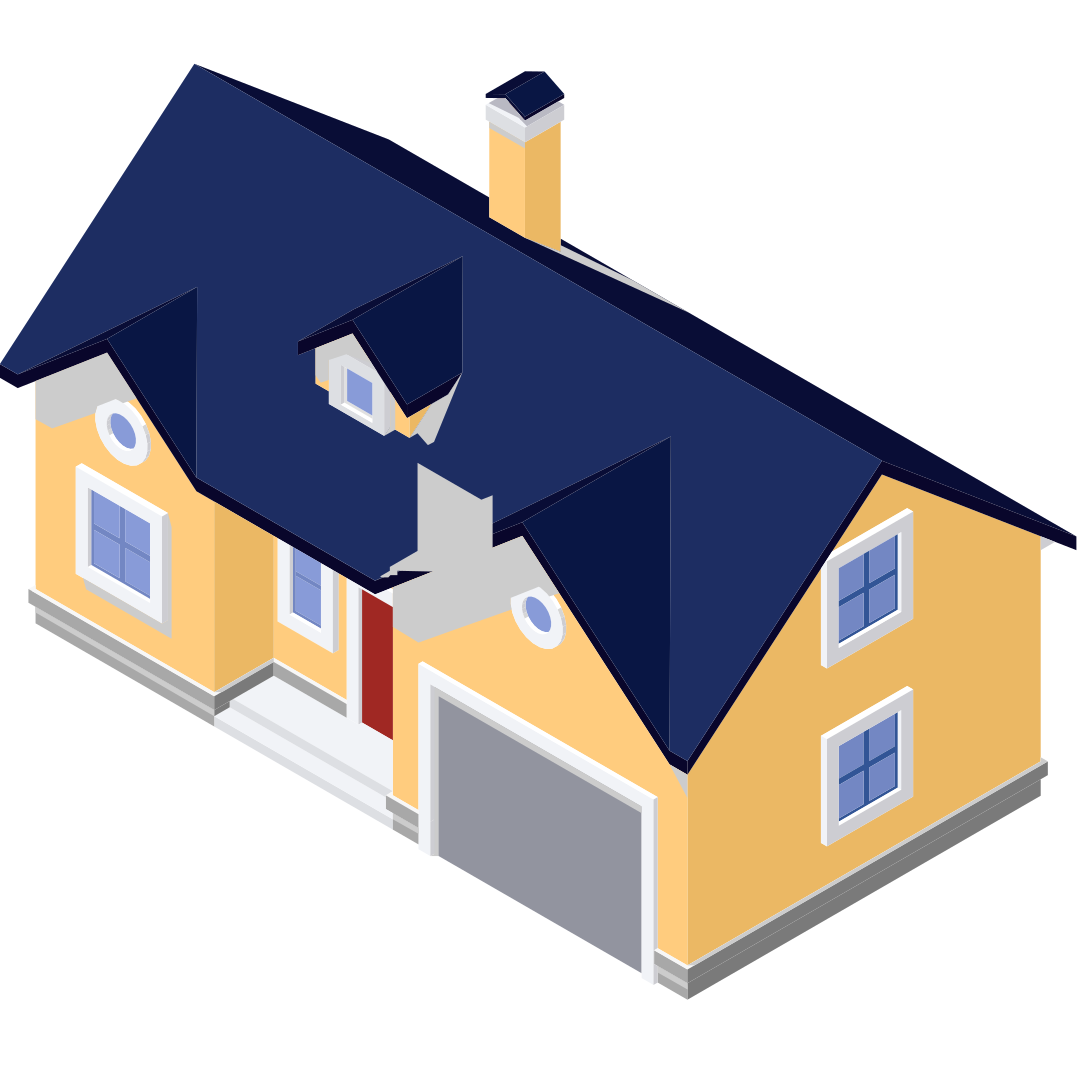


You may qualify with as little as 3% down.

NAF offers competitive interest rates.
Use a Conventional loan to buy a home, build one from the ground up, or refinance the one you own.

No private mortgage insurance with a 20% down payment.
Follow some simple steps to prepare to apply for a Conventional loan online today

You’ll typically need a minimum credit score of 620*, a debt-to-income ratio of 43% or less, and a down payment of 3%-20%.


Pre-approval from your lender can give you security while you shop and give you an estimate of your mortgage amount.

Gather your needed documents like identification, income information like W-2s, and credit and debt reports to finalize your application.
If you think a Conventional loan may be right for your needs, apply today. Or, if you have questions about this, or any of our loan types, talk to one of our loan officers. They’ll be happy to help you on your journey to homeownership.

Ask about our Pathway Down Payment Assistance Programs
Licensed in all 50 States + Washington D.C. and Puerto Rico

Easy online application process and borrower portal
From down payment options to private mortgage insurance,
we’ve got all the information to help you figure out if a Conventional loan is right for you.
Conventional loans are not insured or guaranteed by the government, whereas FHA loans are insured by the Federal Housing Administration, making them more accessible to borrowers with lower credit scores. VA loans are guaranteed by the Department of Veterans Affairs and are available to eligible veterans, active-duty personnel, and surviving spouses. The main differences are in their eligibility guidelines, down payment options, and mortgage insurance requirements.
You can refinance a Conventional loan once you have 20% equity in your home. Refinancing can reduce your monthly mortgage payments and eliminate the need for mortgage insurance. Consider future home prices, current mortgage rates, and the costs involved in refinancing to decide if it’s the right move for you.
Yes, there are down payment assistance programs for Conventional loans, primarily aimed at first-time homebuyers (those who haven't owned a home in the last three years). Eligibility varies as most programs are local and have specific requirements. Research your local and state options and discuss with your lender what assistance might be available for you.
A Conventional loan appraisal can fail because of problems with the property like substantial property damage, poor maintenance, or things that are health and safety hazards. A property can also fail an appraisal if its determined value is lower than the sale price or loan amount. Non-compliance with local building codes and unpermitted improvements can also contribute to appraisal failure.
Conforming Conventional loans adhere to the loan limits and guidelines set by Fannie Mae and Freddie Mac, which are government-sponsored enterprises that purchase, secure, and govern some mortgages. These loans typically have more favorable terms and lower interest rates.
Non-conforming Conventional loans, on the other hand, exceed these loan limits or don't meet the guidelines, often requiring larger down payments and having higher interest rates. A Jumbo loan is an example of a non-conforming loan.
Conventional loan limits, also known as conforming loan limits, are the maximum loan amounts that can be purchased or securitized by Fannie Mae and Freddie Mac. For 2025, the baseline conforming loan limit for a one-unit property in most areas of the United States is $806,500.
In high-cost areas, the loan limit can be higher, with a ceiling of $1,209,750 for one-unit properties. The loan limits also vary according to how many units the property is.
Conventional loans are generally not assumable due to due-on-sale clauses. However, there are sometimes exceptions for certain situations like inheritance or divorce, and for adjustable-rate mortgages under specific conditions.
Yes, you can pay off a Conventional loan early, and the majority of them do not have prepayment penalties. Making extra payments toward the principal balance allows you to build equity faster and reduce the total interest you pay over the life of the loan. While prepayment penalties are rare for Conventional mortgages, it is always best to confirm by checking your loan documents. This ensures you won't face an unexpected fee for paying off your debt ahead of schedule.
The time it takes to close on a conventional loan typically ranges from 30 to 45 days, depending on several factors, including the complexity of the transaction and the lender's processing efficiency. This timeframe allows for processing, underwriting, and finalizing the loan. Your creditworthiness and the property's appraisal can also make an impact on the closing timeline. Overall, you can probably expect a relatively straightforward conventional loan to close within a month to a month and a half.
Conventional loans can be used for vacation or investment properties, but the terms may differ from those for primary residences. Lenders often require a higher down payment, typically 15-25%, and may charge higher interest rates for investment properties. Additionally, rental income from the property may be considered in the loan application process. Borrowers should check with their lender for specific requirements and guidelines.
Conventional loans offer several advantages, including potentially lower interest rates for borrowers with good credit. They provide flexibility in loan terms and can be used for various property types, including second homes and investment properties. A significant benefit is that Private Mortgage Insurance (PMI) is not permanent. You can request to have PMI canceled once you reach 20% equity in your home.
The main disadvantage of Conventional loans is their stricter qualification requirements. Lenders typically demand higher credit scores and sometimes larger down payments compared to government-backed options like FHA loans. If your down payment is less than 20%, the additional monthly cost of Private Mortgage Insurance (PMI) can be a significant expense. These rigorous standards can make it more difficult for some borrowers, especially those with limited savings or lower credit scores, to be approved.
Discover valuable information to help you navigate the world of Conventional loans.
From understanding the benefits to navigating the application process, our articles cover it all.
Whether you are looking to purchase a home or upgrade the one you have, it all starts with choosing the right lender and the right home loan.

Use our mortgage and refinance calculators to help you plan your future today

With more than 407,000 reviews online, you don't have to just take our word for it. Form first-time homebuyers, to veterans, to seasoned investors, NAF is commited to serving our customers on whatever homebuying path they choose.

 Smart Moves Start Here.